
Vida’s journey at Pine Tree Society: How the Early Learning Center became her second home
For Sarah and her husband, Josh, the early months of their daughter Vida’s life were filled with the typical magic of new parenthood. Vida was a bundle of joy—perfectly healthy, playful and always ready for a game of peek-a-boo with her family. But, slowly, that began to change. At 16 months, the words Vida had learned—mama, dada, book—slipped away. She stopped playing with toys. Her eyes, once bright and engaging, grew dark; filled with something her parents could see but not understand.
What followed was a period of uncertainty. After an initial diagnosis of autism, a genetics team discovered Vida had Rett syndrome, a rare, neurodegenerative condition that would impact her mobility and ability to communicate.
“It was like a grenade went off,” Sarah recalled. “I was devastated. I knew she was going to have a very hard life ahead of her.”
From then on, she took it upon herself to look at Rett syndrome with hope rather than devastation. When searching for early intervention, Sarah found herself at Pine Tree Society’s Early Learning Center in Auburn. It was there she met Karen McClure-Richard, director of this specialized preschool.
“Karen held this warmth that made me feel so comfortable from the get-go,” Sarah said. “We immediately connected and it felt like a second home where I could see my child thriving. I cannot imagine our lives without her.”
For Sarah, Pine Tree Society is more than a school; it is a collaborative lifeline.
“Out of all the decisions I’ve had to make in Vida’s journey, the Early Learning Center is the best choice I’ve ever made. They provide an intimate, stable setting where she feels safe.”
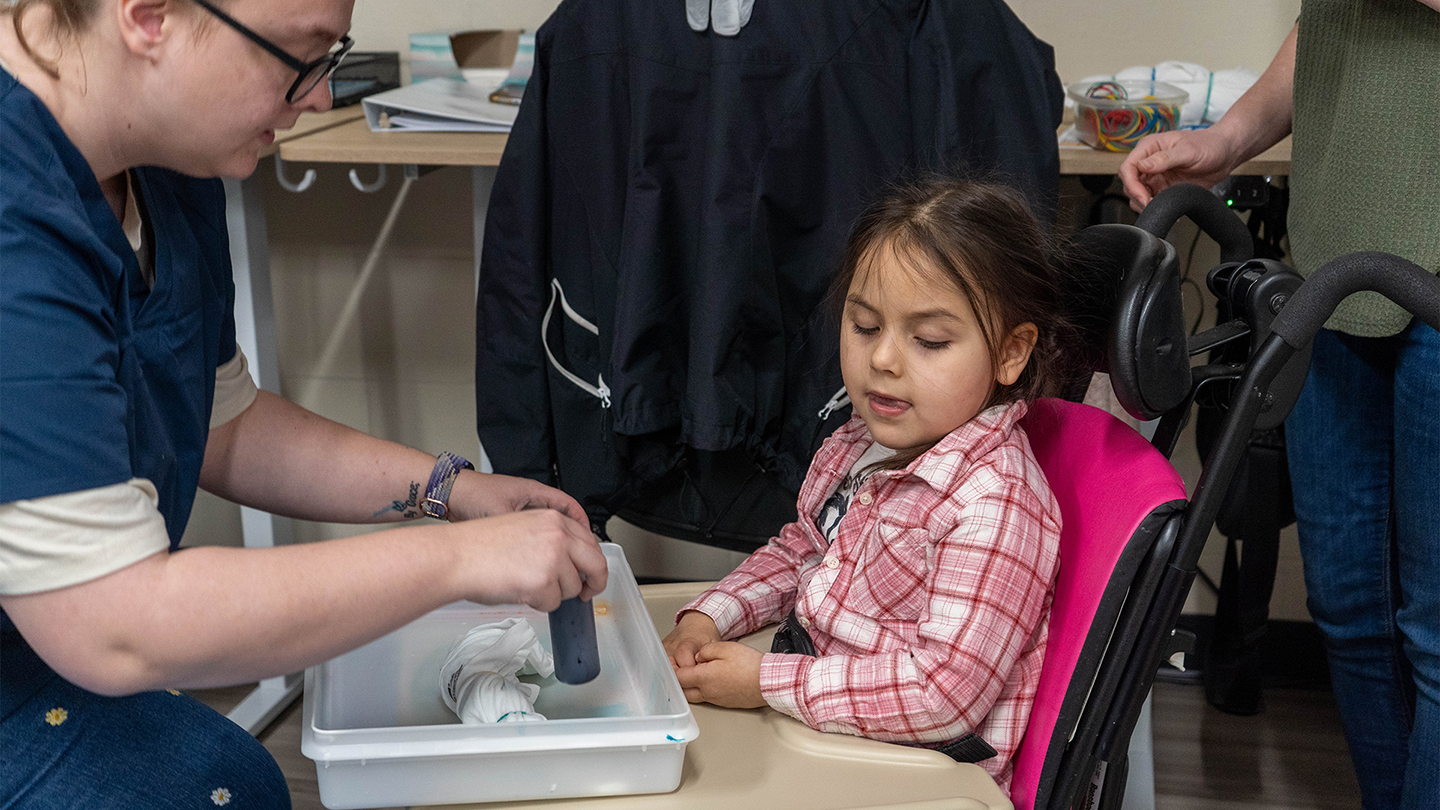
When Vida first arrived, she could barely walk, use her hands or speak. It was isolating. Together, the team developed a strategy that combined Occupational Therapy, Speech-Therapy and Assistive Technology with a structured classroom routine.
“They gained her trust,” Sarah recalled. “Now, she shows up with a smile, ready to be with her friends and experience the simple, beautiful joy of just being a kid.”
Even after difficult periods of illness, the staff’s dedication remains steady. The impact on Vida’s daily life has been profound.
To communicate, she initially used a tablet which required her hands. “She lost that function completely last year,” Sarah said. “So, now, it’s all up to her eyes.” Vida receives medical care at Boston Children’s Hospital and their Assistive Technology specialist suggested a high-tech eye-gaze AAC device for communication. Pine Tree Society’s Speech-Langauge and Assistive Technology Director, Linda Bonnar, is expert in that technology.
“Vida sees therapists day in and day out,” Sarah continued. “There are very few people like Linda. Not a lot of people can see beyond Vida’s struggles. It’s magical to see the two of them working together.”
The occupational therapy Vida receives from Jess Hyde is equally as important.
“With gene therapy, doctors are reversing the loss of mobility in kids with Rett syndrome. The work she’s doing with Jess at the Early Learning Center to build physical strength is critical.”
The collaboration required to help Vida succeed is immense. The Early Learning Center team manages the heavy lifting of communication between private therapists and specialists in Boston, allowing Sarah to focus on being a mother and an advocate.
“The real person who is fighting this battle is Vida. The very least I can do is be her advocate. Be her voice.”
While the focus on a cure for Rett syndrome and the hope of gene therapy keep the family looking forward, Pine Tree Society provides the peace they need now. It is the place where Sarah can drop her daughter off, knowing she is in the best hands possible. She watches her daughter enter the school—smiling, laughing, and ready to learn—knowing she is exactly where she belongs.